
The Crosscurrent
PERSPECTIVE NO. 02 • CITA COLLECTIVE • SEPTEMBER 2026
Younger and older consumers often reach for the same brand. They are not reaching for the same reasons.

KEY FINDINGS
Age-coded meaning can be an asset rather than a liability: in Piper Sandler's fall 2025 survey of 10,969 U.S. teens, 8 percent named New Balance their favorite footwear brand, ranking it third behind only Nike and Adidas.
The commercial stake is substantial: households headed by someone 50 or older accounted for 56 percent of U.S. consumer spending in 2024, according to AARP's Longevity Economy Outlook 2026.
Older participation is not static demand: AARP Research found that generative AI use among adults 50-plus rose from 18 percent in 2024 to 30 percent in 2025, while smartphone ownership reached 90 percent, up from 55 percent in 2016.
The difference between audiences is often the route in rather than the appetite: McKinsey's State of the Consumer 2026 found that 23 percent of Gen Z respondents discovered new brands through social media, compared with 7 percent of Boomers.
What is the Crosscurrent?
A shoe associated with dads becomes a teenage favorite. Earbuds made for everyday listening give people a familiar way to get hearing support. A brand built around childhood play develops sets for adults to display in their homes.
New Balance, AirPods, and LEGO offer different ways to think about a question brands often overlook: what if the age people associate with your product helps someone else see value in it?
This is the Crosscurrent. It is when people find value in a brand partly because of qualities associated with another age group or stage of life. A younger buyer may borrow standing from an established brand. An older buyer may borrow currency from one that feels part of the culture around them.
The same brand can give different audiences different reasons to choose it.
The distinction matters. Broad appeal tells us a brand reaches people of different ages. The Crosscurrent asks whether its age associations help explain the attraction, and what each audience is getting from them.
For brands focused on growth, this opens up a useful possibility. The meaning they already carry may give a new audience a reason to enter. Recognizing that opportunity can require new products, a different message, or a clearer use case. It does not require becoming a different brand.
That is especially relevant to the 50+ market. When younger attention is read as momentum and older participation is filed under loyalty, new demand can go unnoticed. Someone can have known a brand for decades and still be choosing it for the first time.
What is age-coding, and how is it different from age?
Age describes the person. Age-coding describes the brand.
Age as a demographic variable is simply a way to describe and group people by how old they are. It helps size a market and compare behavior. On its own, it does not tell us why someone buys. Two people born in the same year can have very different responsibilities, interests, and priorities.
Age-coding describes the associations attached to a brand, product, or behavior. Who appears in the advertising? Where is it sold? What do people call it? Those cues can make something feel youthful, established, mature, or meant for children, regardless of who actually uses it.
A person's age and a brand's perceived age are different things. A consumer can be drawn to qualities associated with another stage of life without wanting to be a different age.
"Standing" is the credibility a brand has earned over time. "Currency" is its presence in contemporary culture: being seen, used, and part of what is happening now. A product can meet a practical need without offering that sense of participation.
Younger consumers may borrow standing from a heritage brand; older consumers may borrow currency from a contemporary one. These are two ways the Crosscurrent can work, not fixed rules about either audience.
Why does growth strategy default to younger consumers?
It is common for marketing to treat growth as something that begins with younger consumers. Youth has been stereotyped as a signal of what will matter next, so acquisition plans, innovation priorities, and media budgets tend to follow it. Meanwhile, older participation tends to get filed under loyalty and retention.
That default deserves examination. It assumes influence travels in one direction, and it treats an older customer's continued presence as maintenance rather than as demand that can still grow. The Crosscurrent describes what the default cannot see: a single brand drawing people from more than one direction, for different reasons.
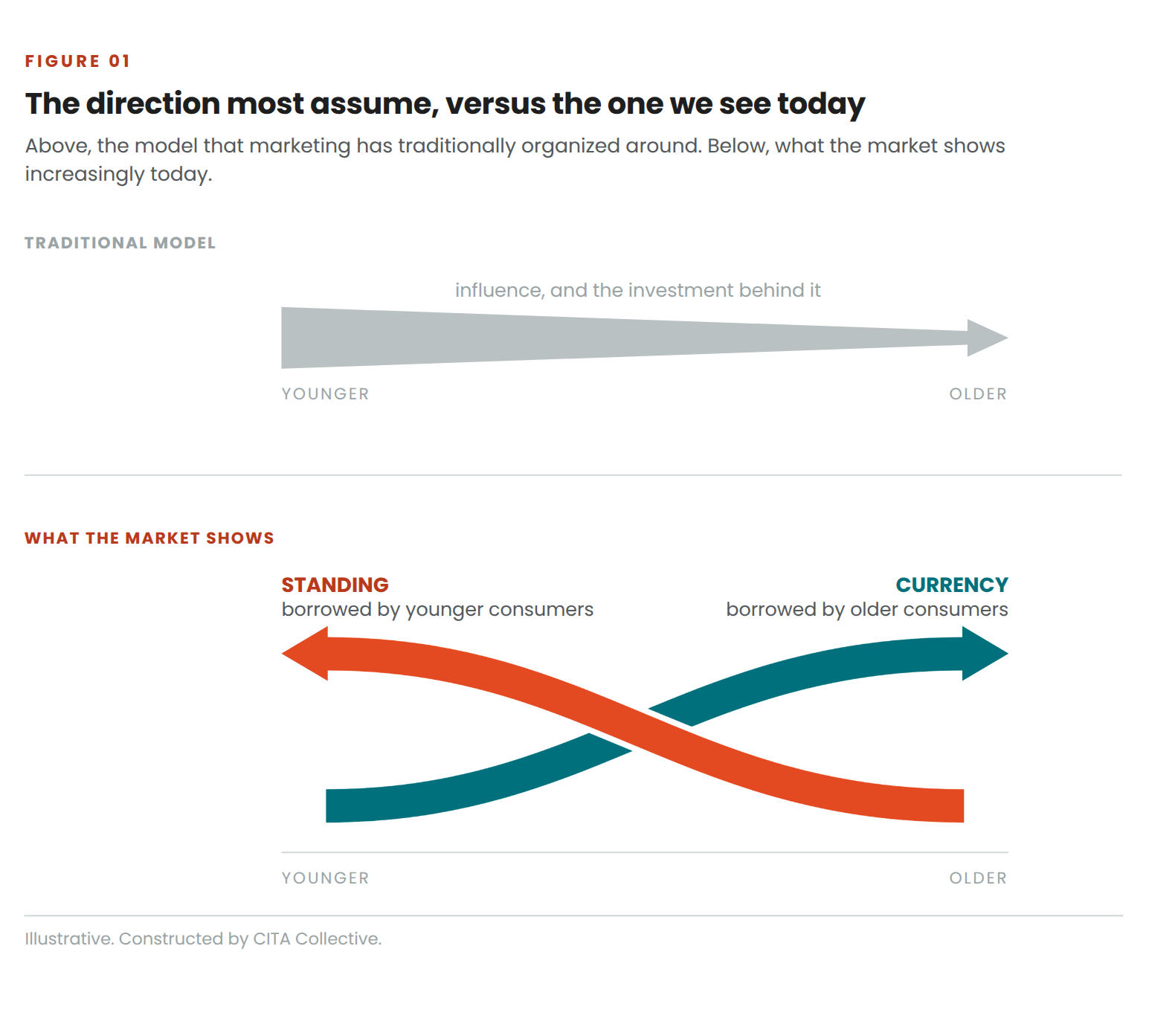
Figure 01. The direction most assume, versus the one we see today. Above, the model that marketing has traditionally organized around. Below, what the market shows increasingly today. Illustrative. Constructed by CITA Collective.
The traditional model is a single arrow of influence, and the investment behind it, running from younger consumers toward older ones. What the market shows is two crossing currents: standing borrowed by younger consumers, and currency borrowed by older consumers, moving in opposite directions at the same time.
The language makes the divide sound wider
"OK Boomer." "Cringe." "Out of touch." In the other direction: "Entitled." "Too sensitive." "Chronically online." The language of generational tension can turn a difference in experience into a verdict about an entire age group.
"OK Boomer" makes the dynamic particularly clear. A person's age becomes a shortcut for dismissing their perspective. Yet the same marketplace that circulates those judgments also makes room for younger people wearing "dad shoes" and adults rediscovering the pleasure of building with LEGO.
So how much of the divide describes what people want, and how much comes from the labels we put on them?
There are real differences between generations. But those differences do not keep people in separate consumer worlds. Even our descriptions can be uneven: a younger person's choice may be praised as vintage or heritage, while an older person's interest in something new may be dismissed as trying to stay young. Brands should be careful not to build those judgments into their plans.
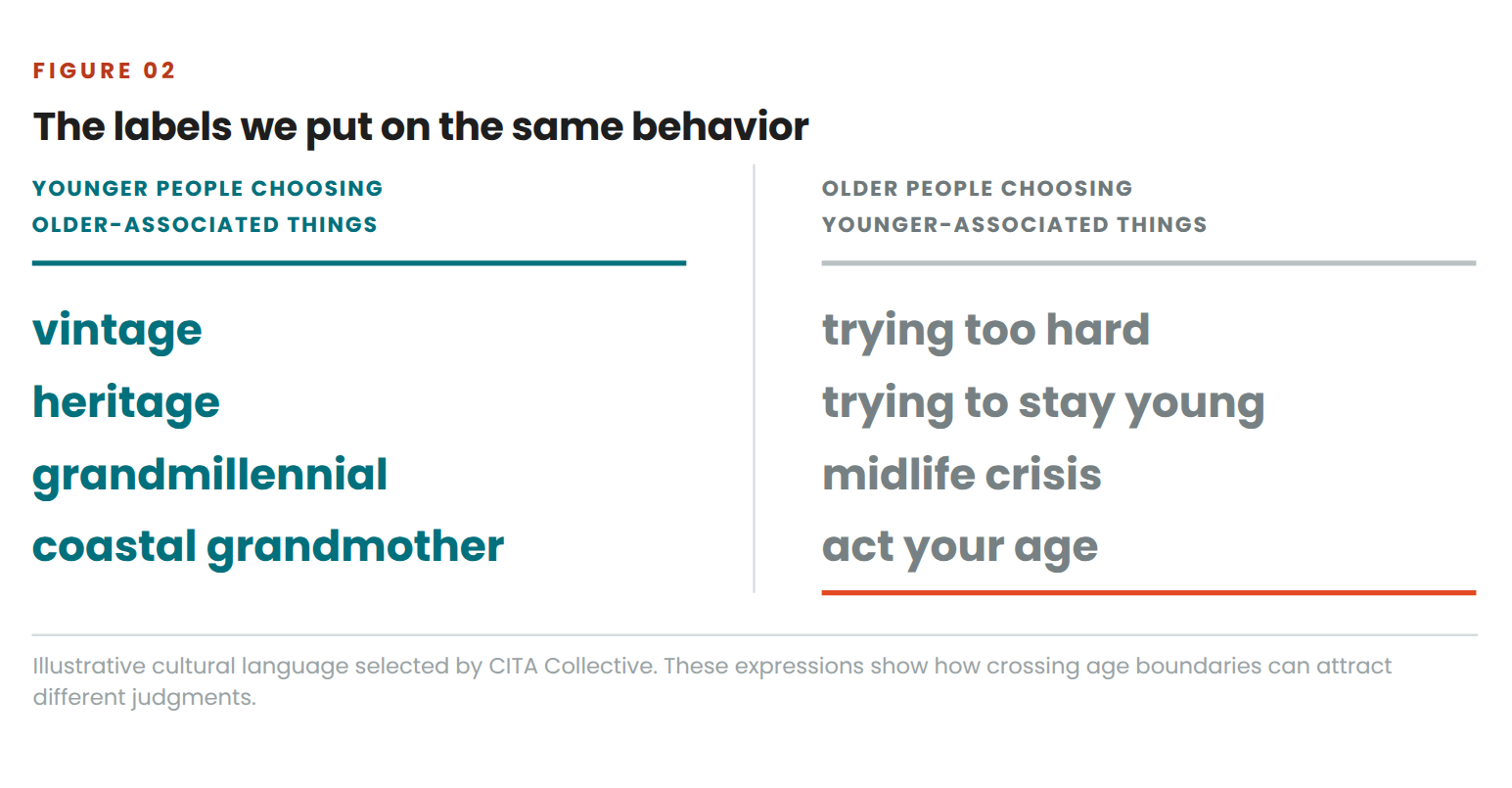
Figure 01. The direction most assume, versus the one we see today. Above, the model that marketing has traditionally organized around. Below, what the market shows increasingly today. Illustrative. Constructed by CITA Collective.
When younger people choose older-associated things, the language is approving: vintage, heritage, grandmillennial, coastal grandmother. When older people choose younger-associated things, the language turns suspicious: trying too hard, trying to stay young, midlife crisis, act your age.
Counter-language exists, but it runs unevenly. When a younger person is called performative, the doubt is about sincerity rather than age. When an older person is praised as an icon, the praise often arrives marked by exception, and the compliment carries the stereotype inside it.
How did New Balance turn the dad shoe into a teenage favorite?
New Balance offers a clear example of a brand working with an age association. Its 2019 campaign described the 990v5 as "Worn by supermodels in London and dads in Ohio." The line made room for fashion and practicality in the same shoe.
The brand also invested in its fashion relevance. In 2021, it appointed Aimé Leon Dore founder Teddy Santis as creative director of its Made in USA line. By fall 2025, that work had changed where the brand stood with an audience far younger than the one it was known for.
CITA's reading is that the familiar "dad shoe" association gave the brand something distinctive to work with. Rather than retire the label, New Balance turned it over. The same plainness that had placed the shoe outside fashion became the reason it read as authentic, and a practicality that once signaled out-of-touch began to signal retro-cool.
That character could become part of a younger buyer's style while still making sense to someone choosing the shoe for fit, function, and comfort. The brand could evolve without treating its existing reputation as something to erase.
8%
of 10,969 U.S. teens surveyed named New Balance their favorite footwear brand in fall 2025, ranking third behind only Nike and Adidas.
AirPods bring hearing support into a familiar product
AirPods illustrate a different opportunity. In September 2024, the FDA authorized hearing-aid software for use with compatible AirPods Pro. The feature was intended for adults 18 and older with perceived mild to moderate hearing loss.
Apple explicitly presented it as a clinical-grade, over-the-counter Hearing Aid feature. It also placed that function alongside hearing protection and a hearing test within a familiar consumer-technology product.
That combination is what interests us. Someone using AirPods Pro for hearing assistance wears the same recognizable product as someone listening to music. For an older person who needs hearing support, the product offers a way to meet that need without making age the most visible part of the experience.
This is where currency matters. The hearing function meets a need; the familiar product places that function within everyday culture. For an older consumer, that combination may make hearing support easier to approach. Brands should investigate its value alongside performance, price, and ease of use.
Why is LEGO making sets for adults?
LEGO brings another dimension to the Crosscurrent. A brand closely associated with childhood has made a deliberate place for adult interests, while keeping building and play at its center.
Through Adults Welcome and its adult-oriented portfolio, LEGO offers sets built around architecture, art, nature, vehicles, and cultural fandoms. These are products designed for adults to build and display, with messaging that presents the experience as a way to relax and enjoy a creative break.
The innovation matters. LEGO expanded what people could make, how the finished objects could fit into their lives, and the reasons to spend time building them. Its familiar system remained recognizable as the portfolio evolved.
LEGO gave them permission to play. The childhood association gives the invitation meaning: an activity someone might have considered no longer for them becomes a legitimate adult pleasure. That can mean returning to something familiar or discovering it for the first time.
Here, adults cross into a world associated with childhood and find room for their present-day interests. The appeal may be creative freedom, nostalgia, or the satisfaction of making something. Permission to play expands our view of what the Crosscurrent can offer.
In its 2025 results, LEGO reported strong demand among children and adults and revenue growth of 12 percent. The lesson behind this is the choice behind the offer: preserve the recognizable experience, then innovate around another audience's interests.
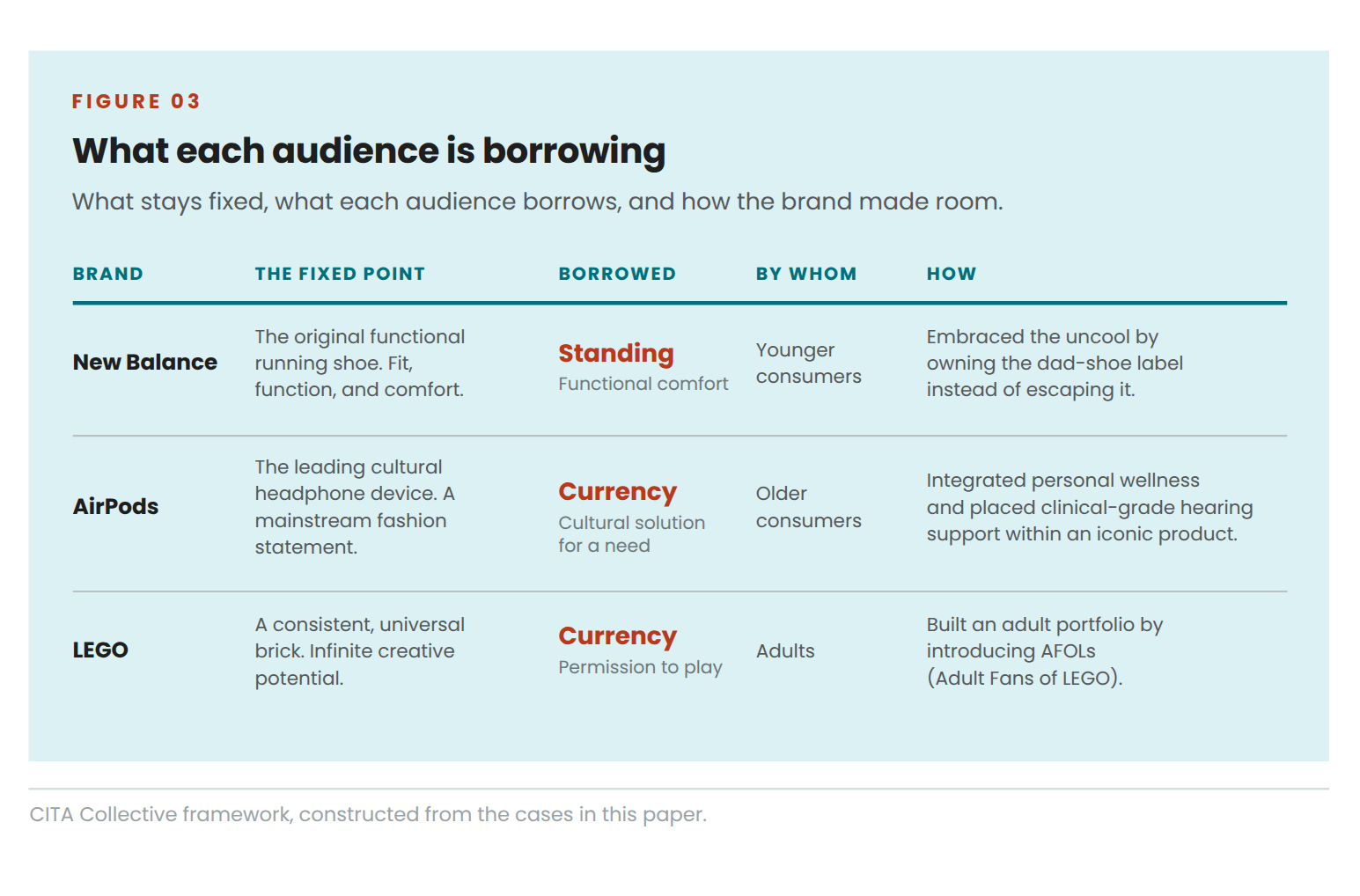
Figure 03. What each audience is borrowing. What stays fixed, what each audience borrows, and how the brand made room. CITA Collective framework, constructed from the cases in this paper.
New Balance keeps the original functional running shoe, with fit, function, and comfort. Younger consumers borrow standing, in the form of functional comfort. The brand embraced the uncool by owning the dad-shoe label instead of escaping it. AirPods keep the leading cultural headphone device, a mainstream fashion statement. Older consumers borrow currency, in the form of a cultural solution for a need. The brand integrated personal wellness and placed clinical-grade hearing support within an iconic product. LEGO keeps a consistent, universal brick with infinite creative potential. Adults borrow currency, in the form of permission to play. The brand built an adult portfolio by introducing AFOLs (Adult Fans of LEGO).
How much do U.S. consumers over 50 actually spend?
The commercial reason to look beyond expected audiences is substantial. Households headed by someone 50 or older accounted for 56 percent of U.S. consumer spending in 2024, according to AARP's Longevity Economy Outlook 2026.
Their participation includes adopting new tools. AARP found that generative AI use among adults 50-plus rose from 18 percent in 2024 to 30 percent in 2025. Smartphone ownership reached 90 percent in 2025, compared with 55 percent in 2016.
Those figures give marketers a practical reason to revisit acquisition assumptions. A 67-year-old seeking hearing support for the first time is entering a category. A 58-year-old beginning to use AI is adopting a new behavior. Age alone cannot tell us whether someone represents retention or new demand.
56%
of U.S. consumer spending came from households headed by someone 50 or older in 2024.
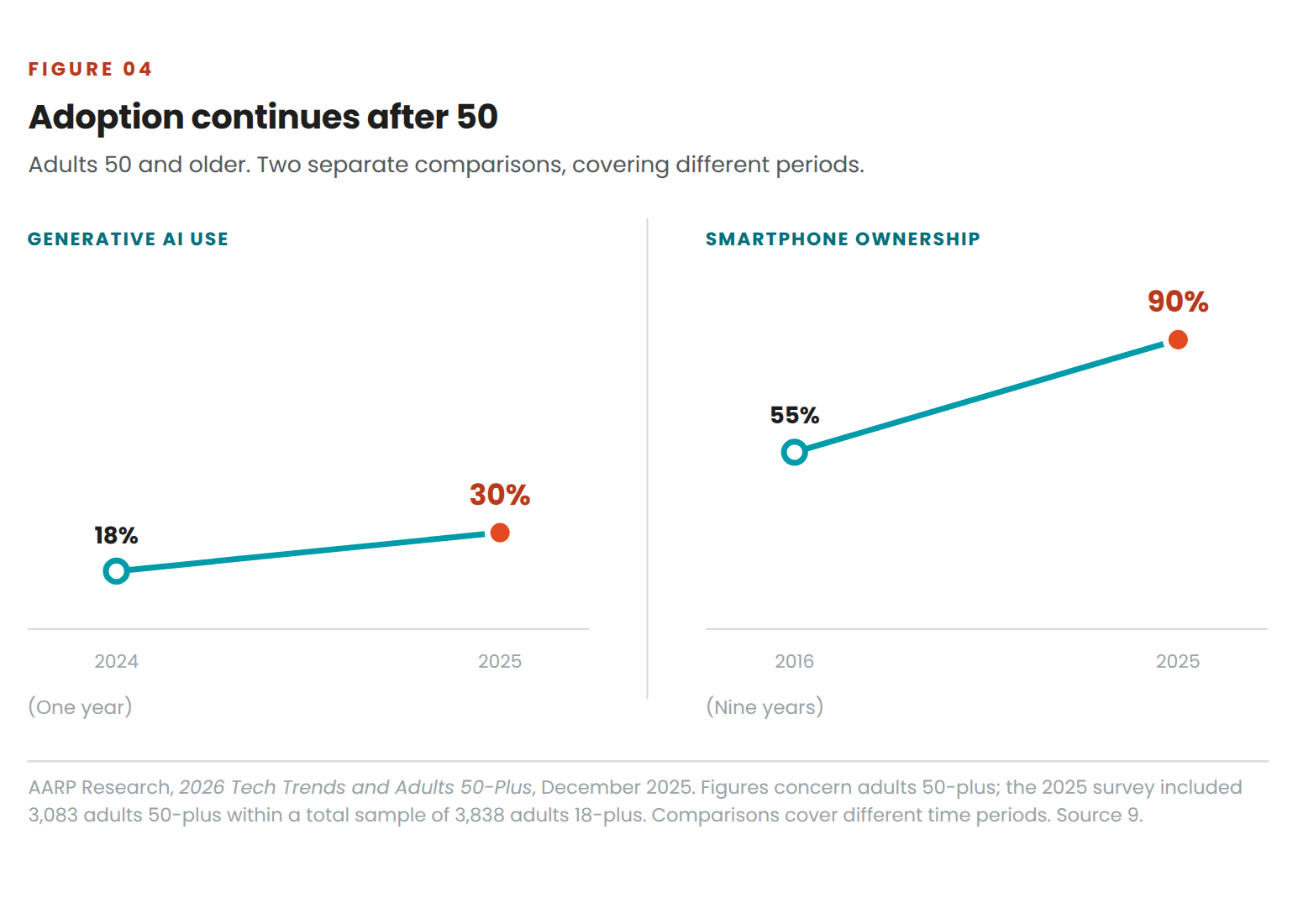
Generative AI use among adults 50 and older rose from 18 percent in 2024 to 30 percent in 2025, a change over one year. Smartphone ownership among the same group rose from 55 percent in 2016 to 90 percent in 2025, a change over nine years.
Help people recognize a place for themselves
Representation alone does not do the work. People need to recognize a credible place for themselves in what a brand offers. A small 2026 qualitative study of 30 Portuguese-speaking participants offers a useful caution rather than a U.S. population estimate.
Younger participants found an intergenerational campaign "hopeful" and "inviting." Older participants read the same polished scene as "unrealistic." Putting several generations in the frame together does not guarantee that each will feel understood. Recognition requires a life that looks true, a role that reads as credible, and a reason to believe the brand sees more than an age bracket.
People also arrive through different channels. McKinsey's 2026 five-country survey found that 23 percent of Gen Z respondents discovered new brands through social media, compared with 7 percent of Boomers. A plan built around social discovery alone risks overlooking other routes into the brand.
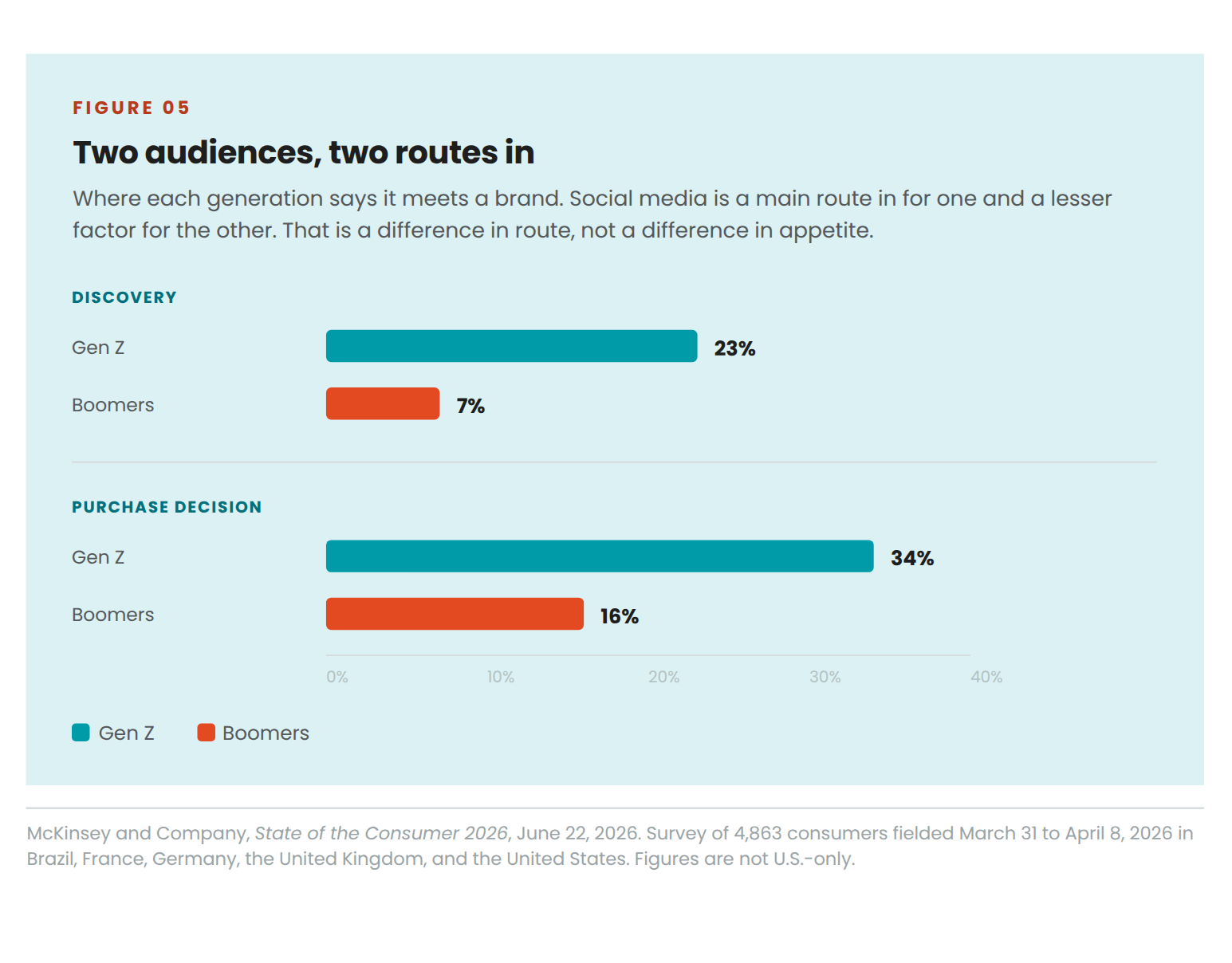
Figure 05. Two audiences, two routes in. Where each generation says it meets a brand. Social media is a main route in for one and a lesser factor for the other. That is a difference in route, not a difference in appetite. McKinsey and Company, State of the Consumer 2026, June 22, 2026. Survey of 4,863 consumers fielded March 31 to April 8, 2026 in Brazil, France, Germany, the United Kingdom, and the United States. Figures are not U.S.-only.
For brand discovery through social media, Gen Z is 23 percent and Boomers 7 percent. For social media playing a role in the purchase decision, Gen Z is 34 percent and Boomers 16 percent.
CITA's view is that age-coded meaning can be a brand asset, and treating age neutrality as the default can be a costly mistake. When brands erase the associations another audience values, they remove a reason to choose them.
Three questions for the growth plan
1. What should remain recognizable?
Identify what people value enough to miss if it disappeared. It might be performance, a familiar experience, or a distinctive design. Protect that value while allowing the product and portfolio to evolve.
2. What is each audience finding in the brand?
Ask people why they choose it, what they associate it with, and whether age plays a role. Are they borrowing standing or currency? What else makes the experience valuable? Look for differences within age groups as well as between them, rather than assigning motives by age.
3. What would make it easier to enter?
Find out whether the barrier is the product, the message, the channel, or the support around it. Test what changes consideration and use. Track first-time customers and new uses by age so that older participation is not automatically counted as loyalty.
The opportunity in plain view
For decades, growth strategy assumed that influence begins with the young. That assumption shaped who marketers watched, who they designed for, and which kind of demand counted as progress. It is a habit, not a finding.
The Crosscurrent points to another pattern. Younger consumers reach for more than novelty. Older consumers take part in culture as it happens. People at different ages are choosing from the same marketplace and finding different value in what they see.
Brands do not have to decide which end represents the future. The more useful question is why each audience is arriving, and whether both can enter without the brand losing what made it worth choosing. Most brands in a Crosscurrent already have both ends. The opportunity is to serve both on purpose.
A reputation that seems to place a brand in one part of the market may be the very reason someone elsewhere chooses it. So the next time a brand looks like it belongs to one generation, it is worth asking who else is already reaching for it, and what they are finding there. That question is where the Crosscurrent begins.
About CITA Collective
CITA Collective is a research and strategy practice dedicated exclusively to U.S. 50+ consumers. We find the truth about the 50+ consumer and help organizations act on it. Through research and strategy, we help create products, services, experiences, and messages that reflect how people are actually living longer lives.
Greater possibilities for longer lives.
Sources
The brand cases are CITA's interpretations of documented actions and market evidence. They illustrate opportunities to investigate; the available data do not establish age-coded meaning as the cause of purchase or business growth.
Dazed. "New Balance's new campaign pays homage to its OG dad shoe." 2019. Contemporary reporting of the 990v5 campaign line. · https://www.dazeddigital.com/fashion/article/44382/1/new-balance-new-campaign-dad-shoe-ugly-sneakers-990v5
New Balance. "Teddy Santis Named Creative Director of New Balance MADE in USA." April 5, 2021. · https://newbalance.newsmarket.com/latest-news/teddy-santis-named-creative-director-of-new-balance-made-in-usa/s/c97fb578-022f-4ea7-ae44-2565d3dc0050
Piper Sandler. Taking Stock With Teens, Fall 2025, 50th edition. Survey of 10,969 U.S. teens, fielded August 8 to September 22, 2025. New Balance ranked third in favorite footwear brands at 8 percent. Findings describe the surveyed teens. · https://www.pipersandler.com/sites/default/files/document/TS_Fall25_Infographic.pdf
U.S. Food and Drug Administration. "FDA Authorizes First Over-the-Counter Hearing Aid Software." September 12, 2024. Authorization covers software for compatible AirPods Pro, for adults 18-plus with perceived mild to moderate hearing loss. · https://www.fda.gov/news-events/press-announcements/fda-authorizes-first-over-counter-hearing-aid-software
Apple. "Apple introduces AirPods 4 and a hearing health experience with AirPods Pro 2." September 9, 2024. Company description of hearing protection, testing, and the clinical-grade Hearing Aid feature. · https://www.apple.com/newsroom/2024/09/apple-introduces-airpods-4-and-a-hearing-health-experience-with-airpods-pro-2/
The LEGO Group. "LEGO Sets for Adults | Adults Welcome" and "Relax, Build and Find Your Flow." Accessed September 2026. Product and positioning sources; adult-oriented offerings are not a 50-plus-specific segment. · https://www.lego.com/en-us/categories/adults-welcome
The LEGO Group. "The LEGO Group delivers record results in 2025." March 10, 2026. Company-reported revenue rose 12 percent to DKK 83.5 billion. The release reports strong demand among children and adults; this paper does not attribute growth to either group. · https://www.lego.com/en-us/aboutus/news/2026/march/the-lego-group-delivers-record-results-in-2025-driven-by-strong-brand-and-innovative-portfolio
AARP. The Longevity Economy Outlook 2026, developed by Economist Enterprise. June 2026. The 56 percent figure concerns spending by households headed by someone 50-plus, not purchases solely by individual adults 50-plus. · https://www.aarp.org/pri/topics/work-finances-retirement/economics-aging/longevity-economy-outlook/
AARP Research. 2026 Tech Trends and Adults 50-Plus. December 2025. DOI: 10.26419/res.01020.001. Survey fielded September 9 to October 6, 2025; total n = 3,838 U.S. adults 18-plus, including n = 3,083 adults 50-plus. Cited figures concern the 50-plus group. AI comparisons are 2024 to 2025; smartphone comparisons are 2016 to 2025. · https://doi.org/10.26419/res.01020.001
Barbosa, I., and Real de Oliveira, E. "Bridging Skipped Generations: Intergenerational Marketing as a Catalyst for Aging Consumer Relationships." Journal of Intergenerational Relationships. Published online March 3, 2026. Qualitative interviews with 30 participants: 10 each aged 18 to 30, 40 to 55, and 65-plus. Findings are culturally specific to Portuguese-speaking contexts and are not U.S. population estimates. · https://doi.org/10.1080/15350770.2026.2636113
McKinsey & Company. State of the Consumer 2026. June 22, 2026. Survey of 4,863 consumers, fielded March 31 to April 8, 2026, in Brazil, France, Germany, the United Kingdom, and the United States. The 23 percent and 7 percent figures concern social-media brand discovery. They are not U.S.-only findings; Boomers do not represent all consumers 50-plus. · https://www.mckinsey.com/industries/consumer-packaged-goods/our-insights/state-of-consumer
© 2026 CITA Collective. All rights reserved. This paper may be quoted or cited with attribution to CITA Collective, The Crosscurrent, Perspective No. 02, September 2026. Data and figures drawn from third-party research remain the property of the cited sources and are reproduced here for commentary and analysis.